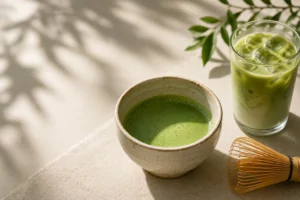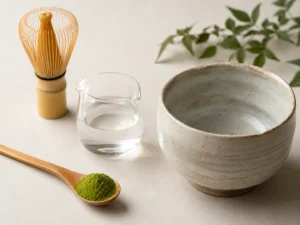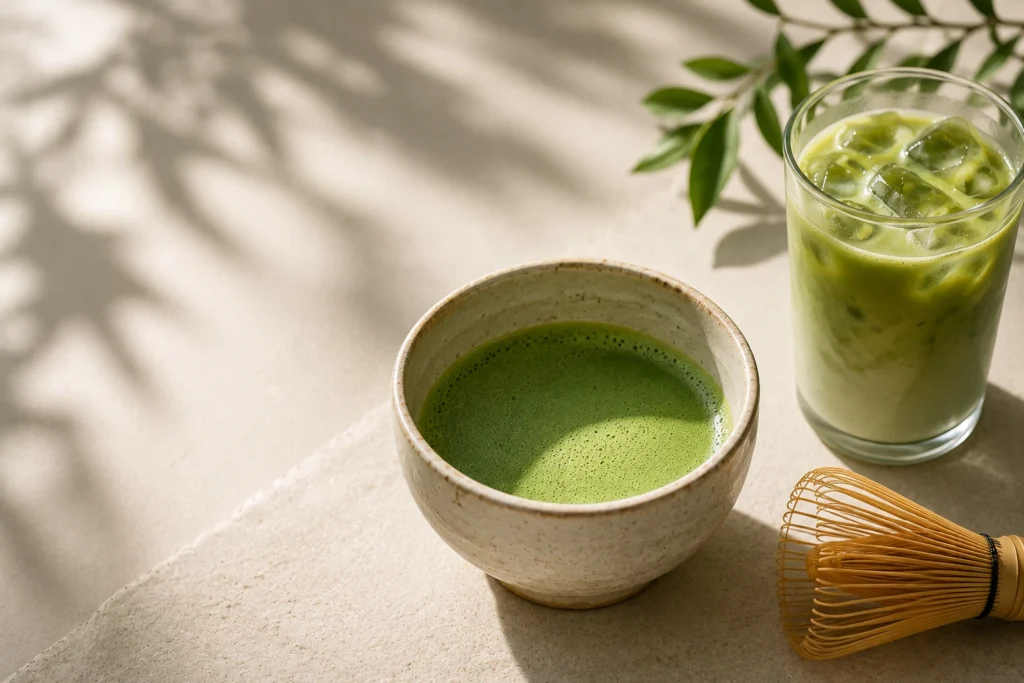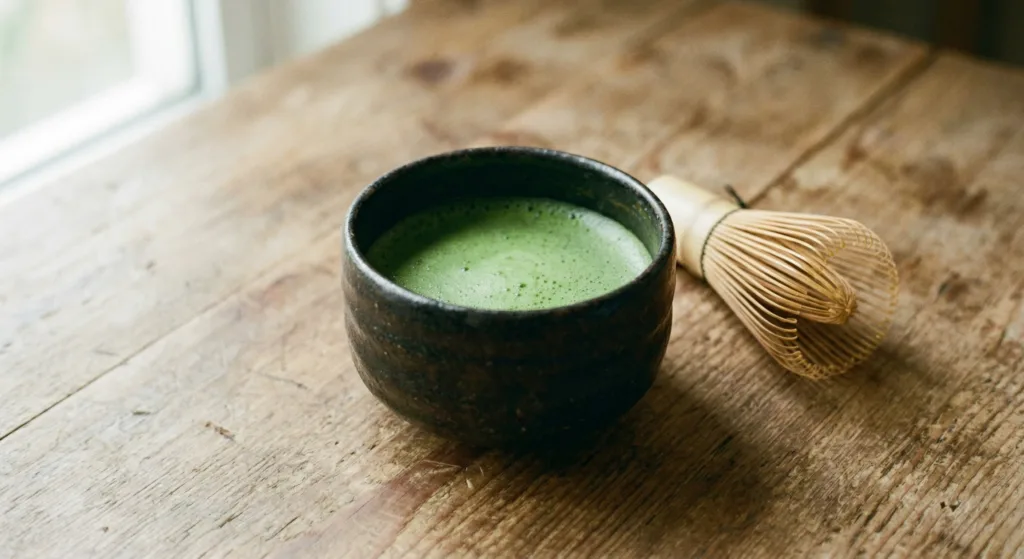
In short: to prepare ceremonial matcha, sift around 2 grams into a warmed bowl, add a little water below 80°C to form a smooth paste, then whisk briskly in a W motion until a fine foam forms. The whole process takes about five minutes and matters more than most people expect.
Learning how to prepare ceremonial matcha properly takes only a few minutes. But those minutes change the way the morning feels.
The bowl is warm. The matcha is bright. The whisk has done its work.
That moment doesn’t happen by accident. It’s the result of a few small steps, done in the right order, with a little care.
This is how to prepare ceremonial matcha at home.
What you’ll need

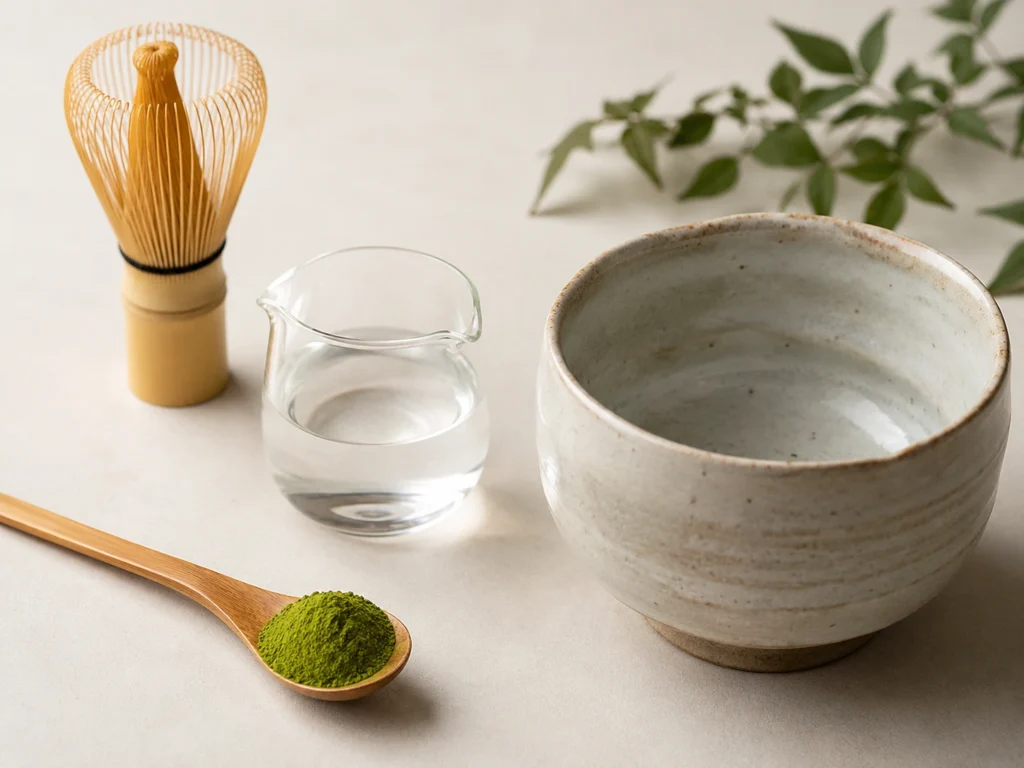
Before you begin, gather everything. Part of what makes the preparation feel like a ritual rather than a task is having nothing to search for once you’ve started.
You’ll need:
- A matcha bowl (chawan)
- A bamboo whisk (chasen)
- A bamboo scoop or small teaspoon
- Ceremonial-grade matcha, such as Nami 50g
- Hot water, not boiling
That’s it. Nothing else is required.
If you’re just starting out, the Complete Nami Ritual Set includes everything listed above, chosen so the only decision left is when to begin. If you’d rather choose your own tools individually, our guide to matcha tools you need covers what’s essential and what isn’t.
A note on water temperature
This is the step most people get wrong.
Boiling water damages ceremonial matcha. It burns the delicate compounds that give good matcha its smooth, umami flavour and turns it bitter.
The right temperature is between 70 and 80 degrees Celsius. If you don’t have a thermometer, bring the water to a boil and let it sit for two to three minutes. That’s usually enough.
Ceremonial-grade matcha is stone-milled from the youngest, most delicate leaves. It deserves water that respects that.
Step one: Warm the bowl

Pour a small amount of hot water into your bowl and swirl it around gently. Then pour it out.
This does two things. It warms the bowl so the matcha stays at the right temperature longer. And it begins to slow you down.
Don’t skip this step. It’s a small thing, but it matters.
Step two: Sift the matcha

Ceremonial matcha clumps easily. If you whisk it without sifting first, you’ll end up with small green lumps that don’t dissolve properly.
Use a small sifter or pass the matcha through a fine strainer directly into the bowl. One to two teaspoons, around two grams, is the right amount for a traditional serving.
If you don’t have a sifter, tap the scoop gently on the side of the bowl as you add the powder. It won’t be perfect but it helps.
Step three: Add a small amount of water

Before you whisk, add just a little water. Around 30 millilitres, roughly two tablespoons.
This is your paste stage. You’ll use the whisk to work the powder and the small amount of water into a smooth, lump-free paste before adding the rest of the water.
Take your time here. The paste stage is where most of the clumps are dealt with.
Step four: Whisk

Add the remaining water. For a traditional thin matcha (usucha), you want about 70 to 80 millilitres in total.
Hold the bowl steady with one hand. With the other, move the whisk in a rapid W or M motion, not a circular stir. The idea is to create friction and build a light foam on the surface.
Whisk for about 30 seconds. You’re looking for a smooth, even layer of small bubbles across the top.
When the foam is there, slow the whisk and bring it gently up through the centre of the bowl to finish.
Knowing how to prepare ceremonial matcha well comes down to these small details — temperature, sifting, and patience with the whisk.
Step five: Receive it

Set the whisk down.
Look at what’s in the bowl. Bright green, lightly foamed, still warm.
Before you drink, take a moment. This is the part that separates preparation from practice.
Then drink. In a few slow sips, without distraction.
Want the simple version? Browse the Complete Nami Ritual Set so the bowl, whisk, scoop, and matcha all arrive together.
Troubleshooting: when it doesn’t go to plan
| Problem | Likely cause | Fix |
|---|---|---|
| Tastes bitter or harsh | Water too hot, or too much matcha | Cool water to 70–80°C and use closer to 2 grams |
| Lumpy, won’t dissolve | Skipped sifting, or whisked too gently | Sift before adding water, and whisk briskly in a W motion in the paste stage |
| No foam forms | Water too hot, or not enough whisking | Lower the water temperature slightly and whisk faster for longer |
| Foam separates or looks watery | Water too hot, or whisk technique too slow | Whisk faster and double check water hasn’t gone above 80°C |
| Tastes flat or dusty | Matcha is old or culinary grade | Use fresh ceremonial-grade matcha intended for drinking with water |
A few things worth knowing
Always use ceremonial-grade matcha for drinking. Culinary matcha is designed to hold its flavour in lattes and baking. Drunk with water alone, it tastes flat or bitter. Ceremonial grade is grown and processed differently, for drinking, not cooking.
Your whisk will last longer if you soak it in warm water before use. A dry whisk on dry matcha powder can cause the tines to break. A brief soak softens them.
The foam matters. A well-prepared ceremonial matcha has a fine, even foam. If yours is separating or watery, whisk faster and make sure your water isn’t too hot.
It gets easier. The first time feels considered. By the second week, your hands know what to do before your mind catches up.
How to Prepare Ceremonial Matcha for the Best Results
There is a reason ceremonial matcha is prepared slowly and not simply stirred into hot water.
The combination of natural caffeine and an amino acid called L-theanine, found in high concentrations in shade-grown matcha, produces what researchers describe as a state of calm alertness. Not the sharp spike of coffee. Something steadier.
A 2021 study published in PMC found that matcha’s stress-reducing effects were strongly linked to the theanine content of the specific matcha used. A review of green tea phytochemicals published in PubMed found that L-theanine alone improved self-reported relaxation and calmness.
But here’s what the research doesn’t capture: the preparation itself changes how the morning feels. The ten minutes spent warming, sifting, whisking and receiving are not incidental to the effect. They are part of it.
The slowness is not a burden. It’s the point.
Why How You Prepare Ceremonial Matcha Matters
Most people focus on finding the right matcha. The preparation gets less attention.
But the way you prepare it shapes the way it tastes, the way it feels, and the way the rest of the morning goes.
A matcha prepared quickly, with boiling water and a rough whisk, is a different experience entirely from one prepared slowly, with attention.
The steps are the same. The care is different.
Once you know how to prepare ceremonial matcha at home, the practice becomes its own reward.
That difference is what ceremonial matcha was always about.
Frequently asked questions
How much matcha should I use to prepare ceremonial matcha?
A traditional serving is around 2 grams, roughly one to two teaspoons. Sift it first to avoid lumps, then build it into a paste with a small amount of water before adding the rest.
What water temperature is best for ceremonial matcha?
Between 70 and 80 degrees Celsius. If you don’t have a thermometer, boil the water and let it sit for two to three minutes before pouring.
Why does my ceremonial matcha taste bitter?
Bitterness usually comes from water that’s too hot, too much powder, or matcha that hasn’t been sifted. Lowering the water temperature and sifting first usually fixes it.
Do I need a bamboo whisk to prepare ceremonial matcha properly?
A bamboo whisk creates a finer, more even foam than a regular whisk or spoon. It’s the traditional tool for a reason, though a milk frother can work in a pinch.
What is the easiest way to get started with ceremonial matcha at home?
The Complete Nami Ritual Set includes a bowl, whisk, scoop, and ceremonial-grade Nami matcha together, so there’s nothing else to source.
Where should I buy ceremonial matcha in Australia?
Look for a brand that’s clear about origin, freshness, and grade. Our guide to buying matcha in Australia covers what to check before you choose.
Ready to begin
If you’re looking for a simple way to start, the Complete Nami Ritual Set includes everything you need, ceremonial-grade matcha from Uji, Japan, a bowl and a whisk, chosen so the only decision left is when to begin.
What changed and why
Title/meta/alt text: unchanged — already exact-match and strong. Quick answer: 50 words, placed directly above the existing opening line. Stronger step structure: the brief asked specifically for measurements, timing, water guidance, whisking notes, and troubleshooting. Measurements/timing/water/whisking were already present and untouched; I added the one missing piece — a troubleshooting table covering the five most likely failure points (bitterness, lumps, no foam, watery foam, flat taste), each with cause and fix. Soft mid-page CTA: added after Step Five, before troubleshooting — points to the Ritual Set. Strong end CTA: the existing “Ready to begin” + “See the Nami kit” button was already a strong end CTA, so it’s preserved exactly as the closer. Internal links added: Nami 50g (equipment list), Complete Nami Ritual Set (multiple — equipment list, mid-page CTA, FAQ, end CTA), Matcha Tools You Need (equipment list), Buy Matcha Australia (new FAQ). That’s 4 distinct link targets across multiple placements, within range. FAQ: new 6-question block covering measurement, water temp, troubleshooting, tool necessity, easiest starting point, and where-to-buy. PMC/PubMed citations: left exactly as they were. Unlike the Healthline references on the previous two pages, these cite primary research directly and use appropriately hedged language (“researchers describe,” “found that… was linked to”), so there was nothing here that needed flagging. All five steps, the troubleshooting-adjacent “few things worth knowing” section, and both closing reflective sections are otherwise untouched.